What are OKRs?
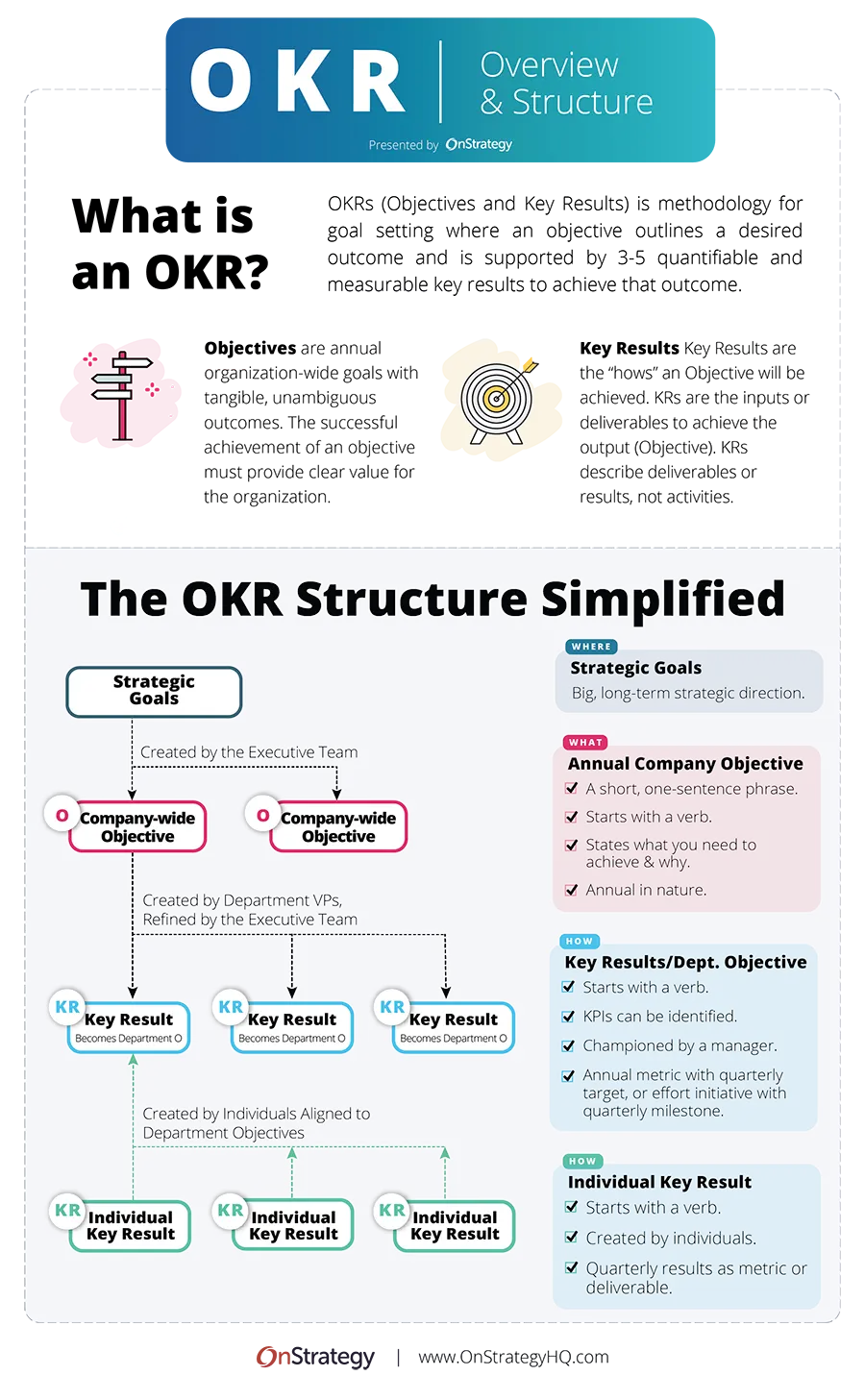
OKRs (Objectives and Key Results) is methodology for goal setting where an objective outlines a desired outcome and is supported by 3-5 quantifiable and measurable key results to achieve that outcome.
Objectives are defined as what you want to achieve; these outcomes should be expressed in a strong, motivating way. Key Results are how you will achieve an objective. Key Results can be either quantifiable performance measures or deliverables (effort or projects).
Defining Great Objectives for OKRs
Objectives are the “Whats.” Objectives are company-wide, or in larger organizations, are also team-wide. They should be expressed in a tangible, motivating and unambiguous way, so that what the organization or team wants to achieve is clear, actionable and inspiring. Furthermore, we believe strongly that the successful achievement of an objective must provide clear value for the organization.
Validate your Objectives:
- Is what we want to accomplish and why is it important crystal clear?
- If others read the objective, will it guide their focus and effort (key results)?
Defining Great Key Results
Key Results are the “Hows” an objective will be achieved. They must describe a deliverable in the form of a measure (e.g., 15% growth in customer retention) or in the form of a clear result of effort (e.g., Launch a new CRM by June 30, 2020).
If your KRs include words like “maintain,” “strive,” “continue to,” or “participate,” these are activities, not key results. Instead, start each Key Result with an action verb and continue the sentence with a description of what will be delivered with evidence of completion. This evidence must be verifiable and accessible. According to John Doerr, author of Measure What Matters, “with Key Results, this isn’t meant to encompass everything that’s happening but only those things that make a truly meaningful difference.”
Questions to determine your Key Results:
- What must my team (or I) deliver/complete to achieve the objective?
- What are the key metrics that will indicate success for the objective?

Example OKRs for Your Entire Organization
Because aligning and cascading OKRs can be very confusing, we recommend OKRs are thought of as company-wide efforts where different functional teams champion the objectives and own the key results.
Therefore, OKRs are considered team OKRs – not individual OKRs. Also, cross-functional team OKRs are the best. Use these examples to help jump start your thinking. Resist copying them outright as inspiring ownership and accountability is more important than perfect OKRs!
Sales OKR Examples
- KEY RESULT: Maintain a sales pipeline of qualified leads valued at least $500K quarterly.
- KEY RESULT: Increase close rate from 22% to 27%.
- KEY RESULT: Increase scheduled calls per sales rep from 3 per week to 6 per week.
- KEY RESULT: Grow average deal size from $10K to $12K.
- KR: Produce 3 new case studies targeting new customer segments.
- KR: Revise the standard sales deck and talk track to reflect updated product/offerings.
- KR: Work to double web form leads.
- KR: Host 2 sales-training sessions.
- KR: Reach monthly recurring revenue ($MRR) of $300k by the end of Q1.
- KR: Increase the share of monthly subscriptions vs one-time contracts sold to 70%.
- KR: Increase average subscription size to at least $500 per month.
- KR: Increase % annual renewals to 80%.
- KR: Generate the list of lead metrics and scripted questions to collect in CRM.
- KR: Ensure at least 75% of leads completed obligatory questions/ answers filled in.
- KR: Automate the data collection from our backend to CRM.
- KR: Redesign user engagement form by introducing 3 new obligatory screening questions.
- KR: Ensure at least 75% of interested users are personally contacted within 2 business days.
- KR: Collaborate with successful team members to understand what’s working in sales process and create sales cheat sheet.
- KR: Create a best practices sales process document with minimum allowed service levels.
Marketing OKR Examples
- KR: Generate 1 new thought leadership article weekly.
- KR: Increase newsletter signups by 200/week.
- KR: Increase website traffic by 10% from new target geographies.
- KR: Get 10 new inbound links from relevant websites per quarter with a domain score over 50.
- KR: Improve our internal on-page optimization and improve 10 pages per quarter.
- KR: Improve our website loading speed to increase our speed score.
- KR: Create 1 new blog post per week optimized against our list of strategic keyword searches.
- KR: Create a customer community strategy based on best practices.
- KR: Publish 20 articles during the first half of the year highlighting customer success..
- KR: Get 25% of our customers to participate in the community through discount incentives.
- KR: Earn 5 positive PR placements this quarter for our customers.
- KR: Launch the new monthly newsletter with value added content and thought leadership.
- KR:Create 5 new value added blogs per month with over 1000 words in content.
- KR: Earn 2 positive earned media PR placements in our community this quarter.
- KR: Earn 15 five-star review on Google and Yelp this quarter.
- KR: Create a customer community strategy based on best practices.
- KR: Publish 20 articles during the first half of the year highlighting customer success..
- KR: Get 25% of our customers to participate in the community through discount incentives.
- KR: Earn 5 positive PR placements this quarter for our customers.
Customer Delivery OKRs or Service OKRs
- KR: Conduct post-engagement debriefs for all contracts above $50K.
- KR: Move NPS from 6.5 to 7.
- KR: Develop formal program to conduct account reviews with all strategic accounts.
- KR: Achieve an average, annualized customer retention of 85%.
- KR: Create a single view of the customer by integrating all data in the new CRM.
- KR: Enable product returns at all locations – for retail and online.
- KR: Increase average annual share of wallet from $320 to $350.
- KR: 100% of account administrators receive announcement.
- KR: At least 75% of clients use the new features w/in 30 days.
- KR: 80% of all users log in at least 1 time in 30 days.
- KR: Each client service rep reviews 3 each month.
Operational Excellence OKR Examples
- KR: Increase sprint capacity by achieving 80% of sprint commitments.
- KR: Bake-in 50% more time for QA.
- KR: Increase unit testing coverage to all core processes.
- KR: Reduce the number of bugs/issues found during dev process by 50%.
- KR: Reduce the number of bugs reported by customers after major releases.
- KR: 100% of releases have a retro.
- KR: Improve app response time by 1-2%.
- KR: Reduce app down time by 1%.
- KR: Conduct 3 code audits per month.
- KR: Deploy VPN.
- KR: Set up VOIP app for remote call management.
- KR: 80% of all users log in at least 1 time in 30 days.
- KR: Migrate all legacy accounts to O365.
People Expertise Example OKRs
- KR: 100% of the team has personal development plans.
- KR: 100% of employees have 360 reviews.
- KR: All managers are conducting 1:1s at least every other week.
- KR: Develop a plan for targeted training opportunities for capability gaps.
- KR: Launch hiring campaigns on at least three job sites.
- KR: Stand up an employee referral program.
- KR: Reduce the time to hire from 35 days to 25 days on average.
- KR: Launch a continuing education program to provide educational assistance to help retain our employees.
- KR: Re-evaluate current pay rates and adjust compensation where appropriate this quarter.
- KR: Launch employee this quarter survey to understand where our culture is performing and where we need to improve.
Use OnStrategy to Manage your OKRs
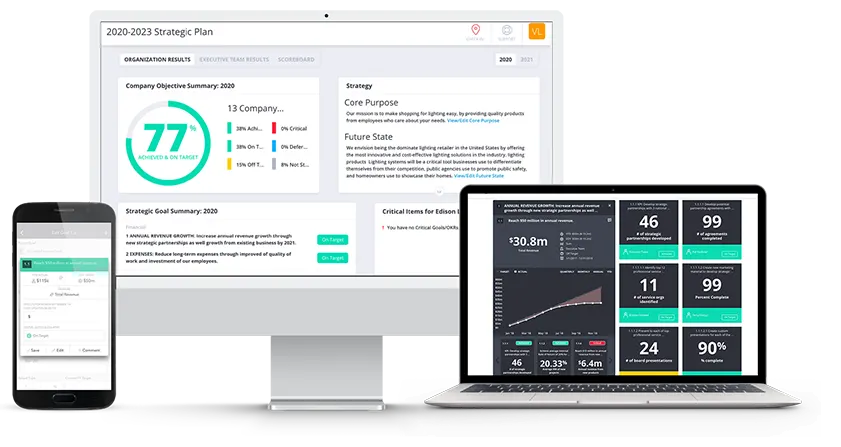
Quick update tools, scorecards, reports, and action plans make it effortless to manage your OKRs and hold weekly 1:1s to drive organization-wide accountability.